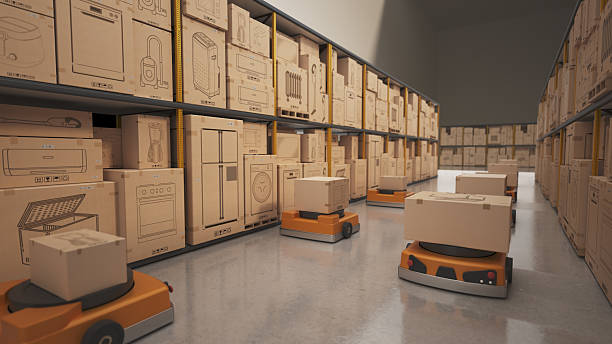
Few decisions in a warehouse are as hard to reverse as how stock is held. A crane-served structure fixes the layout for a decade or more, while a fleet of robots can be re-routed over a weekend. That difference in flexibility matters as much as the difference in capacity, and it is why the ASRS vs traditional storage debate now includes a third option. For many Canadian operators, AMR warehouse robots are the piece that turns ordinary racking into something much closer to an automated building.
This guide compares the three approaches on capacity, cost and fit, and explains where each one belongs. If you want the technology basics first, start with ASRS systems explained for Canadian warehouses. For the robot side of the story, see how autonomous mobile robots transform material handling.
Racks, Cranes and Roaming Robots: Defining the Three Models
Manual storage is the familiar baseline. People on lift trucks and on foot put pallets and cartons into racking and take them out again, with the aisle width and the walking built around that routine. An ASRS replaces the operator inside the rack with a crane, shuttle or carrier running in a fixed lane. If you want the fundamentals, MTLI's guide explains what an ASRS is and how its main formats differ.
The third model sits between the two. Autonomous mobile robots move goods without changing the racking itself, which is why the contrast between automated storage vs manual storage is often drawn too sharply. Our overview of warehouse automation shows where each technology fits in the wider picture. For a quick primer on the robots, read the AMR and AGV basics.
What a Crane-Based ASRS Delivers and Where It Stops
A crane or shuttle ASRS packs inventory into a tall, narrow structure and retrieves each load automatically. The result is the highest storage density of any option here, because aisles shrink to the width of the load and the structure rises to the building's clear height. Among the available warehouse storage solutions, it is also the least flexible once built, since the lanes, heights and throughput are engineered into the structure.
That rigidity is the trade-off for density. An ASRS rewards stable, predictable inventory and a clear growth plan, and it penalizes a business whose product mix changes every year. What to consider before automating storage and retrieval explains how to test that fit before committing. When the project proceeds, ASRS installation covers the structural, electrical and controls work as one scope.
What AMR Warehouse Robots Add to Racked Buildings
An autonomous mobile robot navigates by sensors and a map rather than a fixed rail or guide wire. It can route around obstacles and be added to a fleet one unit at a time. In a racked building the robots take over the movement, carrying totes or carts between pick zones and packing, or bringing shelving to a station, while the racking stays conventional. That is the main difference from a crane-based build: nothing about the structure has to change.
Robots do not raise storage density by themselves. What they remove is the walking, which is often the largest share of a picker's day, and that lets an operation run more throughput through the same layout. For how robots differ from guided vehicles, see AMR vs AGV for Canadian facilities. Because people and robots share the floor, safety planning matters too, and warehouse robotics safety covers the main hazards. If you are unsure where to begin, where to start with warehouse robotics is a practical first read.
Matching Each Model to Inventory and Order Profile
The right model depends on what moves through the building and how often it changes. The table below summarizes the main options.
| Model | How stock moves | Best inventory fit | Space impact |
|---|---|---|---|
| Manual racking with lift trucks | Operators retrieve and put away | Many SKUs, modest volumes | Moderate density, wide aisles |
| Crane or shuttle ASRS | Machines in fixed lanes | Stable SKUs, high volume | Very high density |
| Conventional racking with AMRs | Robots carry goods between zones | Changing SKUs, order-driven picking | Same density, less walking |
| Hybrid: ASRS reserve plus AMR picking | Machines store, robots distribute | Large sites with mixed profiles | High density with flexible flow |
Where a site is bound by floor area, high-density warehouse storage is usually the first lever to examine, and it does not always require full automation. Our guide to racking options for dense storage shows the lane-based alternatives. Many larger facilities end up choosing the hybrid row, with dense reserve storage behind a flexible robot-fed picking zone.
Canadian Labour and Market Signals Behind the Shift
Interest in AMR warehouse robots is easy to see in the market data. One analyst estimate values Canada's AMR market at about $46.6 million in 2026, growing to $122.6 million by 2031 at 17.5% a year. The neighbouring autonomous forklift segment is larger. Canada's autonomous forklift market is projected to roughly double from $782 million in 2026 to $1,444 million in 2031. The same source credits labour shortages and e-commerce growth as the main forces behind that adoption.
Those pressures reach a warehouse floor in concrete ways: roles that stay unfilled, picking targets that keep rising and peak periods that stretch crews thin. Our review of how automation helps with warehouse labour shortages looks at what operators can realistically change. Operations in e-commerce fulfillment feel the squeeze first, because order volume swings faster there than storage capacity can follow.
Capacity, Cost and Payback Compared
Equipment price is only one part of the comparison. The honest view of automated storage vs manual storage weighs capital against labour, space and the ability to change course later. The table below compares the three models qualitatively, because real figures depend on building height, SKU count and throughput.
| Cost lens | Manual racking | Crane or shuttle ASRS | Racking with AMRs |
|---|---|---|---|
| Upfront capital | Lowest | Highest | Moderate |
| Storage density | Moderate | Very high | Moderate to high |
| Labour dependency | Highest | Lowest | Reduced travel time |
| Time to go live | Fastest | Longest | Short, phased |
| Tolerance for change | High | Low | High |
| Typical payback driver | Low entry cost | Space and labour | Throughput and flexibility |
A robot fleet can be financed and scaled in increments, which keeps early spending lower and lets results guide each next purchase. An ASRS front-loads cost but returns it through avoided space and labour over a longer horizon. Our guide to reducing warehouse labour costs through automation shows how to measure the labour side. For a site with an existing building, the automation retrofit comparison explains how each path affects uptime.
Planning Errors That Waste Capacity or Capital
The most common error is buying for the technology rather than the problem. A site whose real bottleneck is walking time may not need a crane structure, and a site short of floor area may not be helped by robots alone. Write down the constraint first, whether it is floor space, labour or order speed, and let that choose the model. Fleets also tend to be sized for an average day rather than a peak one, so test AMR warehouse robots against the busiest week of your year.
A second error is treating density as a goal on its own. Pushing every SKU into high-density warehouse storage lanes can slow picking and strand slow movers, so density should follow demand. A third is leaving integration to the end. Robots and cranes both depend on software that talks to your inventory system, and WMS integration with robotics is where schedules most often slip. Finally, older buildings bring their own limits in floors, lighting and legacy equipment, and retrofitting a warehouse for robotics covers what to check.
How MTLI Combines Racking, ASRS and Robotics Under One Plan
MTLI Group start with how your stock moves and where your floor space is lost, and only then recommend a model. Whether the answer is conventional racking, a crane-based build or AMR warehouse robots working alongside both, we plan the layout, power and controls together so no part of the scope falls between vendors.
That joined-up approach is what separates strong warehouse storage solutions from a collection of equipment purchases. Our warehouse automation services cover ASRS, conveyors and automation retrofits, and our ASRS installation team handles the build when automation is the right call. Operators in 3PL and logistics often benefit most, because client inventory profiles shift. See our projects and case studies for examples across Canadian sites.
Plan Your Next Capacity Upgrade Around AMR Warehouse Robots
Choosing between crane-based systems and robotic solutions starts with understanding your warehouse layout, inventory flow, and order volumes. Book a call with our specialists to discuss your requirements and explore suitable storage options. The initial estimate is free, with a response within 24 hours and no obligation to proceed. You can also contact our team to learn more.