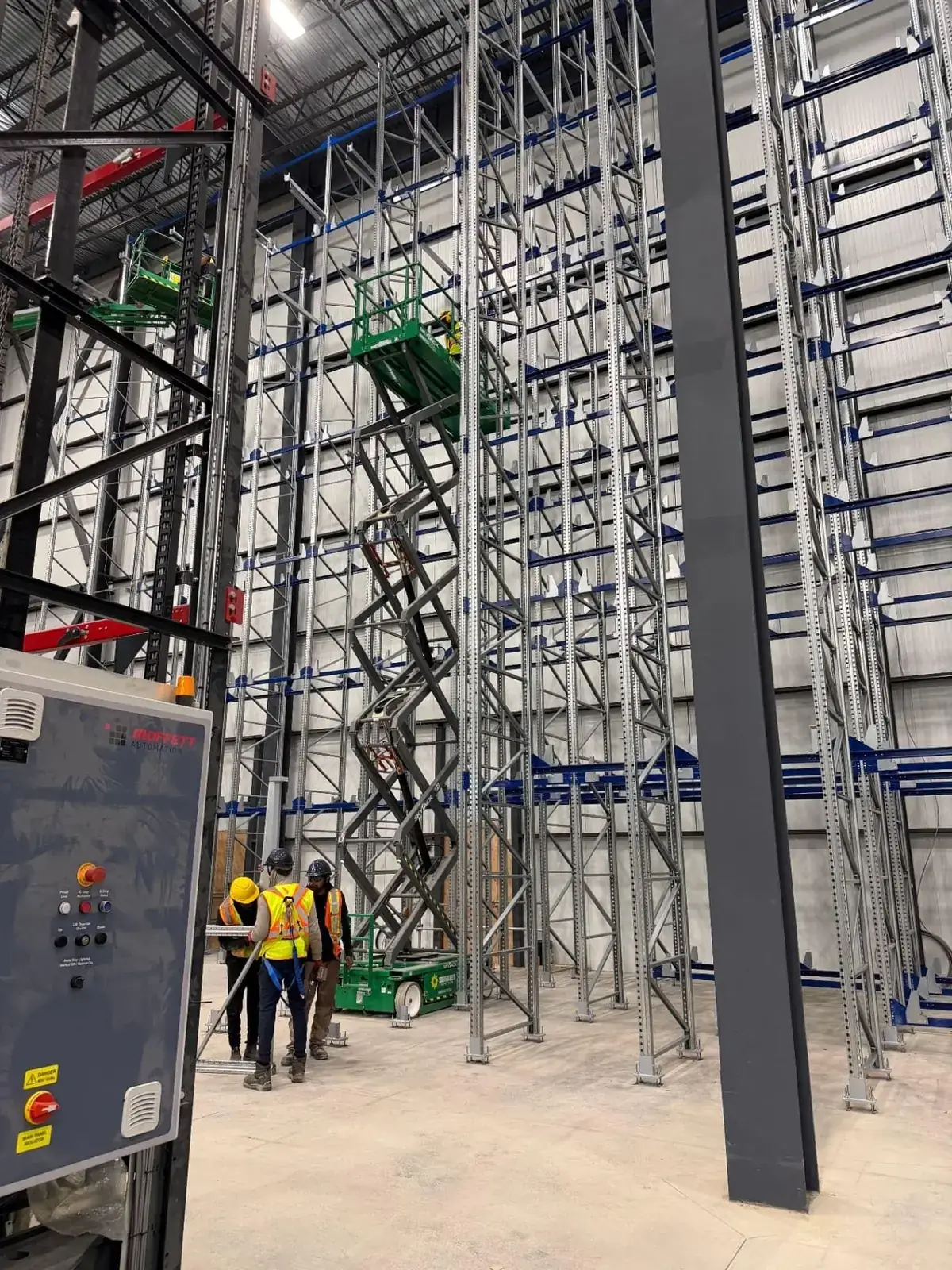
Storage capacity can become a challenge long before a facility has the option to expand its building. As inventory levels increase, adding conventional racking may consume more floor space while also increasing forklift travel and manual handling. An Automated Storage and Retrieval System, or ASRS, provides another way to increase storage capacity by using automated equipment to place and retrieve inventory within a high-density storage environment.
MTLI Group has worked with facilities across Canada on automated storage and material-handling projects. This guide explains what an ASRS company does, how different ASRS technologies address different operational requirements, what should be evaluated before installation, and which questions can help determine whether a provider has the capabilities your facility needs.
Understanding What an ASRS Provider Actually Handles
An ASRS company designs, engineers, supplies, integrates, and installs automated storage equipment that can place and retrieve inventory with limited manual intervention. Depending on the application, the equipment may use automated cranes, shuttle vehicles, lifts, or robotic technology to move pallets, totes, cartons, and other unit loads between storage locations and designated input or output points.
For facilities considering a broader automation strategy, warehouse automation solutions can bring ASRS together with shuttle systems, goods-to-person technology, conveyors, robotics, controls engineering, and other material-handling equipment. MTLI Group's current automation offering includes ASRS and high-density automated storage as well as controls engineering, electrical integration, commissioning, and automation retrofits.
A company that only supplies equipment may leave the facility responsible for coordinating several other contractors. A provider with broader engineering, integration, and installation capabilities can reduce the number of separate handoffs involved in taking an automated storage project from concept to operation.
Comparing ASRS Technologies for Different Storage Requirements
| ASRS Type | How It Works | Best Fit |
|---|---|---|
| Unit-load ASRS | Automated cranes retrieve full pallets from high-bay storage positions | High-volume pallet storage, manufacturing, distribution, and cold storage |
| Mini-load ASRS | Cranes or shuttles handle totes, cartons, and smaller unit loads | High SKU counts, piece picking, and smaller-item storage |
| Shuttle systems | Shuttle vehicles move loads within rack levels while lifts transfer inventory between levels | High-throughput operations requiring flexible storage and retrieval |
| Vertical lift modules | Automated trays are stored vertically and delivered to an operator at an access point | Small parts and facilities with limited floor space |
| Robotic grid storage | Robots travel across a storage grid to retrieve bins and deliver them to workstations | High-density, high-throughput fulfilment operations |
Why the Right ASRS Company Matters More Than the Equipment Brand
Two facilities can install the same manufacturer's ASRS equipment and see very different results, because performance depends as much on design and integration as on the hardware itself. A poorly sized system, or one where the warehouse control and execution software does not properly coordinate with the existing WMS, can underperform its rated throughput even with correctly functioning equipment.
Statistics Canada's Survey of Advanced Technology found that difficulty integrating new technology with existing systems was cited by 34.7 percent of businesses that had not adopted advanced technologies, one of the top three obstacles reported. An experienced warehouse automation systems integrator reduces that risk by managing software integration as part of the original design, not as a separate line of items handled by a different company.
Assessing the Building Before Equipment Is Selected
An automated storage system can place significant demands on a facility's physical infrastructure. This is especially true for high-bay applications, where the storage structure, loaded inventory, automated equipment, and building conditions all need to work together.
Floor loading should be reviewed before the system is finalized. Automated equipment and densely loaded storage structures can create concentrated loads that differ from those associated with conventional warehouse racking. Identifying reinforcement requirements early can prevent expensive modifications later in the project.
A clear height is another important consideration. Using more vertical space can substantially increase storage capacity without expanding the building's footprint, but the available height must accommodate the rack's structure, equipment travel, fire protection, lighting, and other building requirements. High-bay projects that push well beyond conventional racking heights often end up functioning as a rack-supported building, where the storage structure itself carries part of the building's load.
For heavier applications, structural racking systems can provide the engineered load capacity required for demanding storage environments. MTLI's structural racking services include custom configurations, long-span designs, heavy-load applications, cold-storage environments, and seismic-rated designs.
Engineering and compliance should also be addressed before installation. Racking engineering and permits can cover load calculations, seismic analysis, permit drawings, code compliance, and reviews of existing racking systems.
Handling these requirements during the design stage helps prevent a situation where equipment has already been specified, but the building requires unexpected structural or permitting changes.
Questions to Put to an ASRS Vendor Before Signing
Before selecting an ASRS company, operations managers should ask questions that reveal how much responsibility the provider can actually take for the project.
- Does your team provide structural engineering and permitting, or are those services handled by another contractor?
- How will the ASRS communicate with our existing warehouse management and control systems?
- What information do you need to determine the right storage capacity and throughput?
- How does your account for projected SKU growth and future volume increases?
- Can you provide examples of projects with similar storage requirements or operating conditions?
- Who will manage mechanical, electrical, controls, and equipment installation?
- What testing and commissioning procedures are completed before go-live?
- What support is available after the system is operational?
- Can installation be phased if our facility must continue shipping and receiving during the project?
Installation of ownership deserves particular attention. MTLI's equipment installation process for automated systems covers ASRS, shuttle systems, pick modules, goods-to-person systems, AGVs, and AMRs, with support for electrical and controls integration and commissioning.
Avoiding Problems That Can Reduce ASRS Performance
One of the most expensive mistakes an ASRS company can help a facility avoid is sizing an automated storage system only around current requirements. A facility may have enough capacity when the system launches but struggle several years later if SKU counts, inventory levels, or retrieval volumes increase significantly.
Choosing an inappropriate system type can create another problem. A solution that maximizes pallet density may not be suitable for an operation that needs extremely frequent access to individual cartons. Conversely, a highly flexible system may not provide the most economical solution for predictable, high-volume pallet storage.
Existing automation should also be considered before replacement is automatically assumed. In some cases, automation retrofits can modernize controls, improve performance, add new capabilities, or connect older systems with newer software without replacing the entire installation.
Maintenance planning is another area that should not be postponed. Automated storage equipment contains mechanical components, sensors, controls, drives, and software that require ongoing attention. Establishing preventive maintenance responsibilities, spare-parts requirements, response procedures, and inspection schedules during the original project can help protect system availability after commissioning.
How MTLI Group Approaches Automated Storage Projects
MTLI Group approaches ASRS projects as integrated automation and infrastructure programs rather than treating storage equipment as a standalone purchase. Its current automation services cover ASRS and high-density automated storage, shuttle systems, goods-to-person solutions, conveyors, robotics, controls engineering, electrical integration, and automation retrofits.
This broader approach allows an ASRS company to consider storage equipment, structural requirements, controls, electrical systems, installation, and commissioning together during project planning.
MTLI also supports warehousing and distribution operations with infrastructure and automation solutions designed around challenges such as capacity constraints, labor shortages, throughput bottlenecks, and aging facilities.
This approach can also be useful for facilities planning future expansion. A project that considers additional storage capacity and potential automation phases from the beginning is generally easier to expand than one designed only around immediate requirements.
Planning for Long-Term ASRS Performance
Choosing an ASRS company is a long-term operational decision. The system can influence storage capacity, retrieval speed, labor requirements, material flow, building utilization, and facility expansion options for many years after installation, which is why it pays to look at how warehouse automation improves efficiency over the full lifespan of a project, not just at commissioning.
The provider should also be able to discuss how the system can respond to changing business requirements. Inventory may increase, SKU profiles may change, order volumes may rise, and operating schedules may expand. Bringing these possibilities into the original design conversation can help prevent an automated storage system from becoming a capacity constraint later.
Reviewing completed automation projects can also give operations managers a better understanding of the types of facilities, technologies, and project requirements a provider has handled previously.
MTLI Group works with operations teams across Canada to evaluate storage requirements and develop automated solutions around current capacity needs and future growth. Book a call to discuss your facility and determine whether an ASRS approach fits your storage and material-handling goals.