A picker in a typical distribution center spends a large part of every shift walking, not picking. That travel time adds up across a shift, a week, and a year, and it is one of the main costs operations managers try to reduce when they look at automation. AMR warehouse robots address this directly by bringing product to the worker instead of sending the worker to the product.
MTLI Group has helped facilities across Canada plan and install AMR warehouse robots as part of larger automation projects. This guide explains how AMR warehouse robots work, the material-handling tasks they can perform, where they can deliver the greatest operational value, and what warehouse operators should consider before introducing them into an existing facility.
What Are AMR Warehouse Robots?
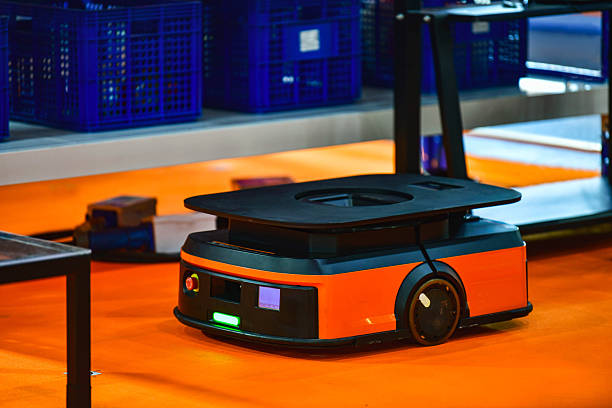
An Autonomous Mobile Robot (AMR) is a self-driving unit that moves through a facility using sensors, cameras, and onboard mapping software to plan its own route. Unlike older automated equipment that follows a fixed track, an AMR reads its surroundings and adjusts in real time. If a pallet blocks an aisle or a worker step into its path, the robot reroutes rather than stopping the whole system.
Unlike older automated equipment that follows a predetermined track, an AMR can respond to changes in its environment. If a pallet temporarily blocks an aisle or a worker step into its path, the robot can detect the obstacle, slow down or stop, and adjust its route when an alternative path is available. This allows AMRs to continue supporting material movement without requiring the entire operation to stop whenever conditions change.
This flexibility separates AMR warehouse robots from Automated Guided Vehicles (AGVs), which follow a fixed path such as a wire or magnetic strip embedded on the floor. AMRs work well in facilities where layouts change often; aisles stay busy with foot traffic, or a fixed infrastructure investment does not make sense yet.
How AMRs Fit into Broader Warehouse Robotics Solutions
AMR warehouse robots are often most effective when they operate as part of a connected warehouse robotics solution rather than as an isolated technology. A facility may combine AMRs with conveyors, robotic arms, automated storage systems, barcode scanners, and warehouse software to coordinate the movement of goods from one process to the next. For instance, AMRs can transport totes or shelving units to stationary picking employees, while robotic arms take care of palletizing or case handling further along the workflow. This combination allows each technology to perform the task it is best suited for while software coordinates the overall operation.
The table below breaks down the main task AMRs handle in a typical warehouse, along with how each task changes daily operations.
| Task | How AMRs Handle It | Typical Impact |
|---|---|---|
| Goods-to-person picking | Bring shelving pods or totes directly to a picking station | Cuts picker walking time, raises lines picked per hour |
| Inventory transport | Move totes or cartons between zones without a fixed guide path | Reduces reliance on manual carts and forklifts for short moves |
| Order consolidation | Carry partially completed orders between stations for final assembly | Speeds up multi-item order fulfillment |
| Returns and replenishment | Move stock from receiving to storage or from storage to pick faces | Frees up staff for exception handling instead of routine transport |
| Inventory counting | Carry mounted scanners through aisles on a set schedule | Improves count frequency without pulling staff off other tasks |
Why Operations Managers Are Adding AMR Warehouse Robots Now
Labor tightness in Canada's transportation and warehousing sector remains a factor in these decisions. Statistics Canada reported that the sector's job vacancy rate stood at 2.6 percent in October 2025, with national job vacancies falling to their lowest level since October 2017 even as demand for warehouse output kept climbing. That gap makes it harder for staff peak seasons with manual picking alone.
At the same time, robotics adoption across Canada remains low relative to the potential. Statistics Canada's Survey of Advanced Technology found that only 2.1 percent of Canadian businesses had adopted robotics technologies as of 2022, with manufacturers leading adoption at 8.4 percent. Facilities that add AMR warehouse robots now are still ahead of the broader market, which gives early adopters a labor productivity advantage over competitors still running fully manual operations.
AMR Warehouse Robots vs Traditional Manual Picking
| Factor | Manual Picking | AMR Warehouse Robots |
|---|---|---|
| Picker travel time | High, often the largest share of a picking shift | Low, robots bring product to the picker |
| Layout flexibility | Fixed racking and pick paths | Robots adapt routes without infrastructure changes |
| Scaling for peak season | Requires hiring and training temporary staff | Add robots to an existing fleet as volume grows |
| Setup time | Minimal, but ongoing labor cost is high | Higher upfront setup, lower per-order labor cost over time |
| Error rate | Depends on picker fatigue and training | Consistent, guided by software rather than memory |
Where AMR Warehouse Robots Make the Most Sense
Not every facility gets the same return from adding robots. E-commerce fulfillment operations with high order counts, and many small SKUs tend to see the fastest payback, since travel time reduction compounds across thousands of daily picks. Facilities running ecommerce fulfillment operations with fluctuating order volume also benefit from the ability to add robots incrementally rather than committing to a fixed conveyor investment all at once.
Manufacturing facilities use AMRs differently, often for moving parts and components between production cells rather than for order picking. A facility with a stable, repeatable route between two fixed points may actually be better served by a lower-cost AGV instead, since the flexibility an AMR offers has less value when the path never changes.
Planning an AMR Deployment Without Disrupting Operations
Adding AMR warehouse robots to a live facility involves a few practical steps beyond selecting a robot model.
- 1. Map current pick paths and bottlenecks. Identify where staff spend the most time walking, since this data shapes robot fleet size and zone assignments.
- 2. Confirm floor and aisle conditions. Check for aisle width, floor surface quality, and lighting, since these affect robot navigation accuracy.
- 3. Plan for software integration. AMRs need to communicate with your warehouse management system to know where inventory sits and where orders need to go.
- 4. Start with a pilot zone. Running robots in one section first limits risk and gives staff time to adjust to shared aisles.
- 5. Train staff on shared space safety. Workers and robots share the same floor, so clear protocols for right-of-way and manual override reduce incident risk.
- 6. Build a maintenance plan. A preventative maintenance plan for battery charging, sensor calibration, and software updates keeps the fleet running at expected throughput.
Common Concerns Facilities Raise Before Committing
Cost is usually the first concern, since AMR fleets carry a higher upfront cost than hiring seasonal staff. Facilities that model cost per pick over a multi-year period, rather than comparing sticker price to a single season of labor, usually find the payback period shorter than expected. Integration with existing warehouse automation equipment is another common concern, particularly for facilities that already run through conveyors or an ASRS. A well-planned deployment accounts for this from the design stage rather than treating robots as an isolated add-on.
Staff acceptance also matters more than most facilities expect going in. Workers who understand how robots change their daily tasks, rather than fearing job loss, tend to adapt faster and report fewer near-miss incidents in shared aisles.
How MTLI Group Supports AMR Warehouse Robot Projects
MTLI Group plans and installs AMR warehouse robots as part of full facility automation projects, coordinating fleet sizing, floor readiness, and software integration under one project team. Our installation crews handle the physical rollout while our engineering team confirms the robots work correctly with existing racking, conveyors, and warehouse management software.
Facilities can review completed automation projects that include robotics deployments across manufacturing and distribution sectors before deciding on a pilot scope for their own site.
Ready to Explore AMR Warehouse Robots for Your Facility?
AMR warehouse robots solve a specific problem; the time and cost tied to manual travel across a warehouse floor. They work best as part of a broader plan rather than a standalone purchase, and the facilities that get the strongest results start with a clear picture of their current bottlenecks before choosing a robot's fleet size.
MTLI Group works with operations managers to plan AMR deployments that fit their facility's layout and order profile. Book a call to discuss where AMR warehouse robots could reduce travel time in your operation.