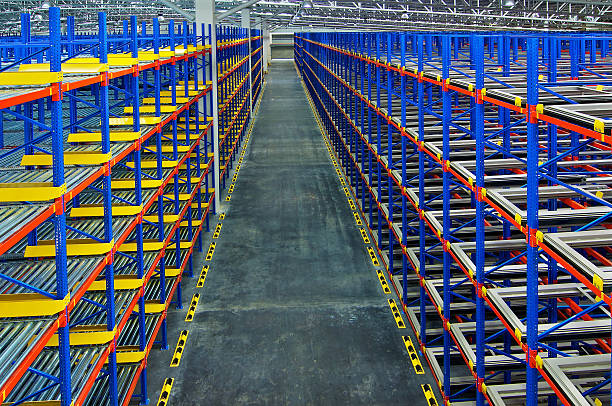
Every warehouse manager eventually faces the same question: do you invest in more racking, or do you invest in robots that move product for you? A warehouse racking system and Automated Mobile Robots, often called AMRs, solve different problems, and treating them as competing options misses how often the right answer involves both. This guide breaks down what each actually does and where the real advantage lies.
For a deeper look at racking fundamentals, our guide on industrial warehouse racking systems in Canada covers the types and benefits in more detail than we can fit here.
Setting the Stage: Fixed Storage vs Moving Robots
A warehouse racking system is fixed infrastructure. Once installed, it stores product in a defined location until someone, or something, comes to retrieve it. AMR warehouse automation takes the opposite approach, using mobile units that navigate the floor to bring product to a picker rather than sending a picker to the product.
Neither approach is universally better. A warehouse racking system gives a facility dense, reliable, low-maintenance storage. AMR warehouse automation adds flexibility and reduces walking time, but it depends on a layout and a budget that can support the technology. Many of the facilities we work with are tracking the direction this debate is heading through resources like our roundup of warehouse automation trends in Canada for the year ahead.
How a Warehouse Racking System Actually Works
A warehouse racking system stores palletized or boxed goods in defined bays, using vertical space that would otherwise sit empty. Selective racking, drive-in racking, and pallet flow racking each offer a different balance of density and accessibility, but all of them share the same core advantage: once installed, they require very little ongoing maintenance or power to keep working.
The reliability of a warehouse racking system is part of what makes it the default choice for most Canadian warehouses. There is no software to update, no battery to charge, and no sensor calibration required. Facilities planning a new racking layout typically work with an installation team that can size the system to current inventory while leaving room for future SKU growth.
How Automated Mobile Robots Change the Picture
AMR warehouse automation introduces a layer of flexibility that a warehouse racking system alone cannot provide. Robots navigate between racking rows, carrying totes or pallets to picking stations, which reduces the walking distance staff would otherwise cover across a large facility. This matters most in operations with high order volume and tight labour availability.
Material handling automation is not limited to robots that roam the floor. Conveyor automation plays a similar role in a more fixed configuration, moving product along defined paths between zones rather than navigating open space. Our conveyor systems team often pairs conveyor automation with AMR deployment, since the two technologies tend to handle different parts of the same workflow well. For facilities weighing this combination for the first time, our explainer on how conveyor systems improve warehouse efficiency is a useful starting point.
Head-to-Head: Cost, Flexibility, and Footprint
| Factor | Warehouse Racking System | AMR Warehouse Automation |
|---|---|---|
| Upfront Cost | Lower | Higher |
| Ongoing Maintenance | Minimal | Software and hardware upkeep required |
| Flexibility to Reconfigure | Limited, physical rework needed | High, routes adjust digitally |
| Power and Infrastructure Needs | None beyond the structure itself | Charging stations, network coverage |
| Best Fit | Dense, stable storage needs | High-volume picking, fluctuating demand |
A warehouse racking system wins on simplicity and cost predictability. AMR warehouse automation wins on adaptability, particularly for facilities in warehousing and distribution that see seasonal swings in order volume. Businesses serving 3PL and logistics clients often lean toward a hybrid of both, since client contracts can change SKU mix and volume with little warning.
What Canadian Data Says About the Robotics Gap
Robotics adoption in Canada remains limited, which shapes how most businesses should think about this decision. National survey data shows that only 2.0 percent of Canadian enterprises had adopted robotics technologies as of 2022, and within the transportation and warehousing sector specifically, the adoption rate was just 0.9 percent, one of the lowest of any sector measured. Manufacturing led all sectors at a much higher rate, showing that robotics adoption varies sharply depending on industry, not just company size.
That low baseline matters for two reasons. First, it means a warehouse racking system remains the backbone of most Canadian facilities, since the majority of operations have not yet layered automation on top of it. Second, it suggests real competitive advantage for businesses in manufacturing and distribution willing to move early on AMR warehouse automation while adoption nationally stays low.
Labour pressure adds another layer to this picture. The Conference Board of Canada estimated that excess job vacancies in the transportation and warehousing sector carried a total economic impact of $5.4 billion in 2022, reflecting how difficult it has become to staff these roles at the pace demand requires. Material handling automation, whether through AMRs or conveyor automation, offers one practical way to offset that gap without depending entirely on hiring.
Calculating Long-Term Value for Each Option
A warehouse racking system delivers value immediately and predictably. Once installed, the return comes from maximized storage density and lower damage rates compared to floor stacking, with no ongoing technology costs to factor in. AMR warehouse automation delivers value differently, through reduced labour hours per order and faster fulfillment, but that return depends on sustained order volume high enough to justify the investment.
| Value Measure | Warehouse Racking System | AMR Warehouse Automation |
|---|---|---|
| Time to Positive Return | Immediate, upon installation | Typically 1 to 3 years |
| Sensitivity to Order Volume | Low | High, needs volume to justify cost |
| Labour Cost Impact | Minimal direct impact | Can reduce picking labour significantly |
| Risk if Business Needs Shift | Low, structure remains useful | Moderate, software and hardware may need updates |
Facilities in cold storage often favour the predictability of a warehouse racking system, since refrigerated environments add cost and complexity to robotics deployment. Operations focused on e-commerce fulfillment, by contrast, frequently find that AMR warehouse automation pays for itself faster, given the high order counts and tight delivery windows typical of that sector.
Mistakes Businesses Make When Picking a Side
The most common mistake is treating this as an either-or decision instead of a layout question. A warehouse racking system and AMR warehouse automation are not mutually exclusive, and many of the most efficient facilities in Canada run both, with robots navigating aisles built around a well-planned racking layout. Choosing AMRs first and retrofitting racking around them afterward often leads to inefficient aisle widths that limit robot performance.
Another frequent error is underestimating ongoing costs. A warehouse racking system has a known, finite cost, while AMR warehouse automation carries software licensing, maintenance, and periodic hardware refresh costs that some businesses do not fully budget for upfront. Skipping a proper facility assessment before committing to either path is a further issue, since floor condition, ceiling height, and aisle width all affect what each option can realistically deliver. Planning this alongside broader facility maintenance and any construction and general contracting work helps avoid costly rework later.
Why MTLI Builds Both Into the Same Project
MTLI Group designs warehouse racking system layouts with future automation in mind, even for clients not yet ready to add AMRs or conveyor automation. This means aisle widths, floor specifications, and racking spacing are chosen to support robotics later without requiring a full redesign. Our conveyor installation team works alongside the racking design team from the start, rather than treating automation as a separate, later-stage project.
For businesses relocating or consolidating facilities, this coordinated approach also simplifies relocation planning, since racking and automation systems designed to work together are far easier to move and reinstall as one coordinated system.
Get the Right Warehouse Racking System From MTLI
A warehouse racking system remains the foundation of nearly every Canadian warehouse, and AMR warehouse automation adds real value on top of that foundation rather than replacing it. The right decision depends on order volume, labour availability, and how much flexibility your operation actually needs.
MTLI Group designs warehouse racking systems built to support both current storage needs and future automation across Canada. For more on how layout decisions affect this choice, see our guide on warehouse design best practices for distribution centres. Contact our team to talk through your facility’s storage and automation plan.