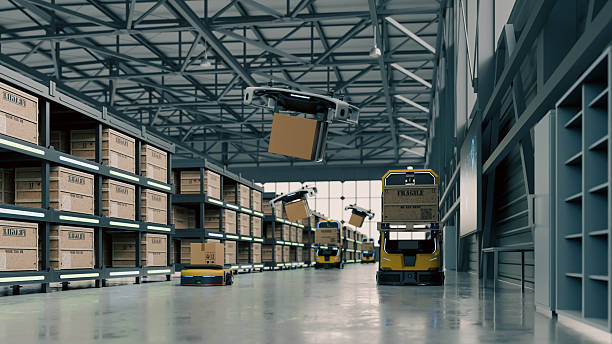
The costliest moment in a robot project is rarely the purchase order. It is month three, when the vehicles are on site and the floor turns out not to be ready for them. Maybe the routes keep moving, the wireless drops in the back aisle or a dock door is too narrow. AMR vs AGV looks like a technology choice, but for most operations it is really a readiness question. The vehicle you can deploy well beats the vehicle that looks better on paper.
This guide is written for operations managers planning a first mobile-robot project. It shows how to test your site, price the work and phase the rollout. If you need the basics first, start with MTLI's guide to AMRs and AGVs. Our companion article on how Canadian facilities weigh the two approaches the same decision from the selection side.
Defining the Terms Before You Write the Request for Proposal
Vendors use these labels loosely, so settle the vocabulary first. An AGV follows a physical or surveyed guide path, such as tape, wire, reflectors or laser targets. An AMR navigates from its own sensors and a stored map, and plans its path as it goes. In an autonomous mobile robots warehouse project, the building changes very little, because the vehicle carries the intelligence.
Writing this distinction into your request for proposal stops vendors from quoting different things under the same name. It also gives your team a shared language, which our overview of warehouse robotics extends across the full range of automation options.
Readiness Check One: Do Your Routes Hold Still?
Guided vehicles reward stability. If most of your moves follow the same path at similar times, guidance can be laid once and used for years. A tugger loop between a kitting area and the line is one example, and a pallet shuttle between inbound staging and a dock is another. Travel times become dependable, and handoffs to conveyors and lifts are easy to engineer.
Ask how often a station, rack row or lane has moved in the past two years. If the answer is "rarely," a guided design deserves a serious look. If the answer is "often," every move will mean fresh guidance work and downtime. Compare conveyor versus AGV systems for the same flow, and consider vision-guided vehicles, which relax some fixed-path limits. A useful AMR vs AGV test is whether your layout is stable enough that a surveyed route will still be right in three years.
Readiness Check Two: Can Your Floor Handle a Moving Fleet?
Autonomous vehicles trade floor work for floor conditions. Dependable wireless coverage, a reasonably flat surface, enough turning room and a place to charge matter more than any guide path would. Walk the building with a checklist. Note wireless dead zones, ramps and thresholds, mezzanine edges, door widths and the spots where people and lift trucks cross.
Where the answers are good, the flexibility is real. Vehicles reroute around blockages, and extra units join the fleet through software. Many warehouse robotics solutions start with a single bounded task, such as replenishment between reserve and pick faces, then expand once the fleet proves itself. These vehicles share aisles with staff, so bring in human-robot collaboration planning before go-live, not after the first near miss.
A Side-by-Side Scorecard for Your Shortlist
Score your site against each row. The column where most of your answers land points to the stronger fit.
| Question about your site | Points toward AGV | Points toward AMR |
|---|---|---|
| How often do routes change? | Rarely | Often |
| Who shares the aisles? | Controlled lanes | Busy mix of people and lift trucks |
| What is being moved? | Heavy, uniform loads | Totes, cartons, mixed loads |
| How will volume grow? | Steady and predictable | Seasonal or uncertain |
| How strong is wireless coverage? | Less critical | Critical |
Few sites score cleanly one way, which is why mixed fleets are common. Guided vehicles cover the heavy trunk routes, and autonomous units serve the variable branches. How warehouse robots share space and follow traffic rules deserves its own plan. If the fleet will also feed an ASRS, design the handoff stations at the same time.
The Staffing Numbers Behind the Business Case
Most approvals hinge on labour. Transportation and warehousing in Canada recorded 28,400 job vacancies in May 2026, a rate of 3.2% that exceeded the 2.8% across all sectors, based on Statistics Canada data. The average wage offered on vacant positions nationally reached $29.55 an hour in the first quarter of 2026.
Persistent hiring gaps combined with climbing pay make manual transport hard to staff and costly to keep. Those numbers sit behind the larger warehouse labour shortage story. They also explain why an autonomous mobile robots warehouse proposal can clear finance on labour savings alone. Operators serving clients in 3PL and logistics feel it sharply, because client volumes swing faster than recruiting can follow. In practice, the AMR vs AGV debate comes down to which approach lets you cover that gap with the fewest new hires.
Building the Budget: Capital, Change and Run Costs
A realistic budget goes beyond the vehicles. Each design puts its spending in different places, and the table shows where.
| Budget line | AGV | AMR |
|---|---|---|
| Capital outlay | Vehicles plus guidance hardware | Vehicles plus fleet software licences |
| Site preparation | Route survey and guidance installation | Wireless upgrades and mapping |
| Cost of change | Guidance reworked | Map and task rules updated |
| Growth | Add vehicles on existing routes | Add vehicles to the fleet |
| Ongoing support | Guidance upkeep and vehicle service | Software updates and vehicle service |
Now put a number on the benefit side. A hypothetical site has ten people on replenishment runs, each working 1,800 hours a year. If robots remove 30% of their walking and cart-pushing, that releases 5,400 hours. At $29.55 an hour, that is about $159,570 a year, before benefits and overhead. Set that figure beside the full budget above, because a sound AMR vs AGV case needs both sides of the ledger.
Stress-test your inputs with our cost-benefit analysis of retrofitting automation. To see where else savings appear, read how automation trims labour costs in picking, receiving and error handling.
Rollout Pitfalls to Plan Around
The first pitfall is launching at full scale. A bounded pilot shows how the fleet behaves in your traffic before you commit the whole building. The second is starting without a baseline. Audit your material flow first, so travel distances and bottlenecks are measured and you can prove what changed afterward.
The third is leaving the software link until late. Robots need task instructions, and early planning of WMS integration for robotics keeps the schedule intact. The fourth is neglecting the people. Supervisors and operators need training on how to work around moving vehicles and what to do when one stops. Finally, treating warehouse robots as a finished purchase misses the point that the real work begins at commissioning.
How MTLI Phases a Mobile Robot Rollout
MTLI Group has delivered more than 15,000 projects across Canada. For robot work, we recommend starting with a site walk and a review of your flows, then a bounded first phase, then a staged expansion. That way the answer to AMR vs AGV comes from your own floor rather than a brochure. Our warehouse automation services cover selection and integration. Our installations team handles mounting, controls and commissioning, so each phase goes live with minimal disruption.
We deliver warehouse robotics solutions as a single accountable scope, including the connection to storage. If your robots will serve an ASRS, our explainer on ASRS in Canadian warehouses shows how that technology works.
Plan Your AMR vs AGV Rollout With MTLI
Ready to test your site against the scorecard? Book a call and a specialist will reply within 24 hours. The estimate is free and carries no obligation. If you would rather start in writing, contact our team with a short description of your building.