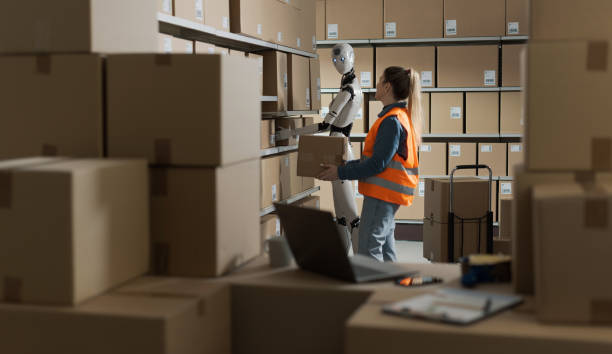
Picking still eats more labour hours than almost anything else in a warehouse. Workers walk miles a day searching, reaching, and carrying product to a packing station, one order at a time. Goods-to-person automation flips that model. Instead of sending people to the product, robots bring the product to the person, cutting travel time to almost nothing.
This guide breaks down how goods-to-person automation works, what it takes to implement, and why it’s gaining ground across Canadian warehouses. MTLI Group’s warehouse robotics guide covers the basics for facility teams exploring this shift for the first time.
What Goods-to-Person Automation Actually Changes on the Floor
In a traditional pick operation, a worker walks to a storage location, retrieves an item, and carries it to a packing or staging area. Goods-to-person automation reverses that sequence. Robotic shelving units or storage pods move directly to a stationary picker, who selects the item and sends the unit back into storage, all without leaving their station.
The impact on travel time is substantial, since walking typically accounts for the largest share of a picker’s shift. Removing that travel lets the same worker handle a much higher volume of orders in the same number of hours. This shift pairs naturally with broader warehouse automation investment, since goods-to-person systems rely on the same underlying software and sensor infrastructure that controls conveyors, sortation, and inventory tracking elsewhere in the facility.
The approach fits particularly well in operations with high order volume and a wide range of SKUs. Facilities in warehousing and distribution often see the fastest gains, since picker travel time tends to be the single biggest drag on throughput in high-SKU environments.
The Hardware and Software Behind the Shift
Several distinct technologies fall under the goods-to-person umbrella, and understanding the difference matters when evaluating robotic warehouse systems for a specific facility.
Autonomous Mobile Robots (AMRs) navigate the warehouse floor independently, using onboard sensors to avoid obstacles and reroute dynamically. Automated Guided Vehicles (AGVs) follow a fixed path, typically marked by floor tape, wires, or magnets, offering more predictable but less flexible movement. Our AMR and AGV guide breaks down when each makes sense for a given facility layout.
Warehouse management software ties the physical equipment together, directing robots to the correct storage pod and sequencing tasks to minimize wait time at each picking station. Getting this software integrated correctly with existing inventory systems is often the most technically demanding part of a rollout, which is why coordinated installation planning matters as much as the robots themselves.
Comparing Goods-to-Person Technologies
Not every facility needs the same type of robotic warehouse system, and the right fit depends on order volume, SKU variety, and existing layout.
Pod-based systems move entire storage shelves to a picker and work well for high-density, high-SKU operations with frequent order turnover. AMR-based shuttle systems move individual totes or cases rather than full shelving units, suiting facilities with lighter, more varied loads. Vertical lift modules bring product down from enclosed, high-density vertical storage, maximizing floor space in facilities with limited square footage.
| Technology | Best For | Typical Throughput Gain |
|---|---|---|
| Pod-Based Systems | High-SKU, high order volume | Significant |
| AMR Shuttle Systems | Lighter loads, flexible layouts | Moderate to significant |
| Vertical Lift Modules | Limited floor space, dense SKUs | Moderate |
Operations focused on e-commerce fulfillment frequently choose pod-based systems to handle high order counts during peak periods, while businesses serving 3PL and logistics clients often favour AMR shuttle systems for the flexibility to adjust quickly as client requirements change.
Why Canadian Warehouses Are Looking at Robotics Now
Robotics adoption across Canada’s transportation and warehousing sector remains unusually low given how much the sector could benefit. National data shows that in 2022, only 0.9 percent of enterprises in transportation and warehousing had adopted robotics technologies, among the lowest adoption rates of any sector tracked, despite manufacturing reaching 8.4 percent over the same period. That gap suggests a significant portion of the sector is still relying entirely on manual picking and material handling, even as order volumes climb.
At the same time, filling warehouse and material handling roles has not gotten any easier. There were 92,600 job vacancies in trades, transport, and equipment operator occupations in the fourth quarter of 2025, up 4.3 percent from the previous quarter. That combination, low automation adoption and persistent hiring pressure, is exactly the gap goods-to-person automation is built to close. Our ROI guide to warehouse automation breaks down how facilities typically calculate the payback on this kind of investment.
What the Investment Looks Like Over Time
Goods-to-person systems carry a meaningful upfront cost, but the return shows up across several measurable categories. Labour efficiency gains come directly from eliminated travel time, often the largest single line item in the business case. Accuracy improves too, since automated systems reduce the picking errors that come from manual searches through dense storage.
Space efficiency is a less obvious benefit but often just as valuable. Dense pod storage or vertical lift systems can increase storage capacity within the same footprint compared to traditional aisle-based storage racking layouts, since narrower robotic aisles replace the wider lanes needed for forklifts and manual pickers.
| Return Category | Source of Savings | Typical Payback Timeline |
|---|---|---|
| Labour Efficiency | Eliminated picker travel time | 1 to 3 years |
| Order Accuracy | Reduced manual search errors | 1 to 2 years |
| Storage Density | Narrower aisles, taller storage | 2 to 4 years |
| Scalability | Easier volume scaling during peaks | Ongoing |
Manufacturing operations managing parts inventory alongside finished goods often see strong returns here too, since manufacturing facilities frequently juggle both high-volume and low-turnover SKUs that benefit differently from automated retrieval.
Rollout Mistakes That Slow Down the Payback
The most common mistake is underestimating the software integration work required before robots ever touch the floor. Warehouse management systems need to communicate cleanly with the robotic control software, and gaps here cause delays that have nothing to do with the hardware itself.
Facilities also sometimes choose a system sized for current volume without planning for growth, forcing a costly expansion within just a few years of installation. Skipping a proper facility assessment, including floor condition, ceiling clearance, and existing racking layout, is another frequent misstep that surfaces expensive surprises mid-project. Pairing a robotics rollout with ongoing facility maintenance planning helps keep the system performing reliably well after installation, rather than treating it as a one-time project with no follow-up. Projects that also involve structural changes benefit from coordinating with a construction and general contracting team early, since floor reinforcement or layout changes are far cheaper to handle before robots arrive than after.
How MTLI Supports a Warehouse Robotics Rollout
MTLI Group manages goods-to-person automation projects from facility assessment through installation and commissioning, keeping design, software integration, and physical build under one accountable team. This avoids the handoff gaps that commonly occur when robotics, racking, and construction are managed by separate vendors.
For clients consolidating or relocating operations, our team also coordinates robotics planning with relocation projects, since a facility move is often the most practical moment to introduce automated material handling without disrupting an already-running operation.
Partner With a Trusted Warehouse Robotics Company
Goods-to-person automation changes the fundamental economics of a warehouse floor, trading picker travel time for speed, accuracy, and storage density. With robotics adoption still low across Canada’s transportation and warehousing sector, businesses that act now have a real opportunity to get ahead of competitors still running fully manual operations.
MTLI Group works as a warehouse robotics company with businesses across Canada to plan and install warehouse automation robots suited to their specific volume and layout. Contact our team to talk through your facility’s automation potential.