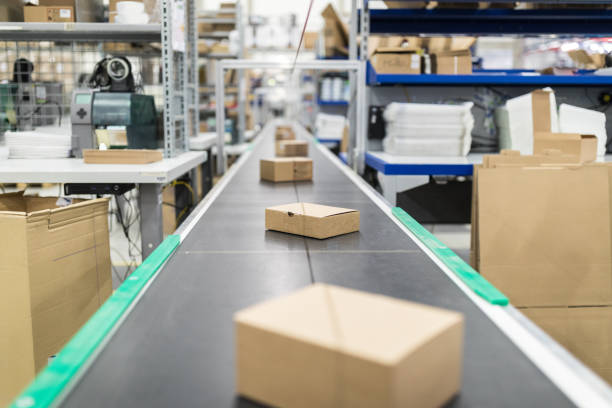
Picture a warehouse worker walking the length of a football field, several times an hour, just to retrieve single items off a shelf. That’s still how most order picking happens today. Goods-to-person automation flips the model entirely, bringing product to the picker instead of sending the picker to the product. The result is fewer steps, fewer errors, and a lot more orders processed per hour.
This guide looks at how automated order picking works, what a conveyor company actually builds to make it happen, and where the technology delivers the clearest return. For a broader primer, our warehouse robotics guide covers the wider category this falls under.
Rethinking the Pick Path: What Goods-to-Person Really Means
In a traditional picking operation, staff walk to a storage location, pull the item, and carry it to a packing station. In a goods-to-person warehouse, that sequence reverses. Conveyors, shuttles, or mobile robots deliver the product directly to a stationary picker, cutting out nearly all the walking.
This isn’t just a convenience upgrade. It changes how a facility plans labour, since picker output becomes far more predictable once travel time is removed from the equation. Our warehouse automation division designs these systems around a facility’s actual order profile rather than applying a generic layout. The shift matters most for operations with high order volume and tight turnaround windows, which is exactly the pressure facing most e-commerce fulfillment centres today.
The Hardware Behind a Goods-to-Person Picking Line
A handful of equipment types do most of the work in a goods-to-person system, and a competent conveyor company builds the system around however these pieces need to interact.
Conveyors move totes, cartons, or trays along a fixed path between storage, picking, and packing. Sortation equipment directs individual items or orders to the right downstream location automatically. Pick-to-light or put-to-light displays guide a stationary picker to the exact item and quantity needed, cutting search time to almost nothing. Robotic picking systems, including robotic arms for repetitive SKUs, now handle a growing share of the physical picking task itself rather than just the material movement around it.
Our conveyor systems team designs the physical backbone that ties these pieces together, while facilities layering in mobile equipment often start with our breakdown of AMRs and AGVs to understand which type of mobile robot fits their floor plan best.
Picking Methods Compared: Person-to-Goods vs Goods-to-Person
The right picking method depends on order volume, SKU count, and how much floor space a facility has to work with.
| Picking Method | How It Works | Best Fit |
|---|---|---|
| Person-to-Goods (Traditional) | Pickers walk to storage locations | Lower order volume, larger SKU variety |
| Goods-to-Person (Conveyor) | Product delivered to a fixed picking station | High order volume, repetitive SKUs |
| Goods-to-Person (Robotic Shuttle) | Automated storage units bring product forward | Very high density, compact footprint |
| Hybrid Picking | Combines manual and automated zones | Mixed order profiles |
Facilities running dense pallet storage alongside a picking operation often pair this comparison with an ASRS installation assessment, since automated storage and retrieval naturally feeds a goods-to-person picking line. Businesses in warehousing and distribution tend to land on a hybrid approach, automating their highest-volume SKUs while keeping manual picking for slower-moving inventory.
The Labour and Adoption Numbers Driving This Shift
Two trends are pushing Canadian operations toward automated order picking faster than expected. Payroll employment in warehousing and storage climbed 7.1 percent year over year as of October 2025, one of the fastest-growing subsectors tracked in the federal payroll survey. That kind of hiring growth signals real strain on labour supply, since every new picking role added competes for the same shrinking pool of available workers.
At the same time, robotics adoption across the Canadian economy remains remarkably low, giving early movers a real edge. National survey data shows that only 2.1 percent of Canadian enterprises had adopted robotics technologies as of 2022, with large enterprises adopting at roughly six times the rate of small businesses. For operations serving 3PL and logistics clients, that gap represents an opportunity, since competitors still running fully manual picking operations are the norm rather than the exception right now.
What Automated Picking Actually Saves
The return on a goods-to-person system shows up in several places at once. Picker productivity typically rises sharply once travel time disappears from the job, since a stationary picker can complete far more picks per hour than someone walking a full warehouse floor. Error rates drop too, particularly when pick-to-light guidance replaces manual order sheets.
Labour flexibility improves as well. A smaller, better-trained picking team can handle a much higher order volume than a larger team working a traditional layout, which matters given how tight the labour market has become in this sector. Our ROI guide for warehouse automation walks through the specific calculations facility managers can use to estimate payback on a goods-to-person project.
| Metric | Traditional Picking | Goods-to-Person Automation |
|---|---|---|
| Picks per Hour per Worker | Lower, travel time included | Higher, travel time eliminated |
| Order Accuracy | Dependent on manual checks | Higher, guided picking |
| Labour Needed per Order Volume | Higher | Lower |
| Scalability During Peak Periods | Limited by available staff | Higher, equipment absorbs volume |
Manufacturing operations handling parts kitting see similar gains, since the same goods-to-person logic that speeds order fulfillment applies equally well to pulling components for a manufacturing assembly line.
Rollout Risks Worth Planning Around
The most common mistake is automating the picking process without first confirming the facility’s electrical and structural infrastructure can support it. Conveyor lines, sortation equipment, and robotic picking systems all draw power and require control wiring that older buildings sometimes cannot handle without upgrades. Projects that skip this step often discover the gap mid-installation, which is far more costly than catching it during planning through our automation equipment installation assessment.
Choosing equipment from multiple vendors without confirming the control systems can actually communicate is another frequent issue, since a conveyor line and a robotic picking arm need to share data in real time to function as one system rather than two disconnected pieces. Coordinating this work with a proper electrical automation plan from the outset avoids most of these integration headaches before they become expensive change orders.
MTLI’s Role as Your Conveyor Company
MTLI Group designs and installs goods-to-person systems as a single accountable conveyor company, handling conveyor design, sortation, and robotic picking integration under one team rather than passing the project between separate vendors. We assess order profile, SKU velocity, and existing storage layout before recommending a specific configuration.
For facilities pairing automated picking with a storage redesign, our storage racking division plans the two systems together, since racking density directly affects how a goods-to-person line gets fed. We also support the system long after installation through ongoing facility maintenance, keeping conveyors, sortation, and robotics running at the speed they were designed for.
Upgrade to Automated Order Picking With MTLI
Automated order picking changes the math on nearly every part of a fulfillment operation, from labour needs to accuracy to how much order volume a facility can actually handle during peak periods. As adoption grows across Canada, facilities that move early position themselves well ahead of competitors still relying entirely on manual picking.
MTLI Group works with businesses across Canada to design goods-to-person systems built around real order data, not a generic template. Contact our team to talk through your picking operation.