In the high-stakes world of logistics and warehousing, the skeletal structure of your facility, the racking system, is the silent engine of your operational efficiency. Choosing the wrong system isn't just a minor inconvenience; it’s a bottleneck that can lead to increased labor costs, wasted square footage, and damaged inventory. As North American supply chains face mounting pressure to optimize every inch of available space, the debate often centers on two industry stalwarts: Selective Racking and Drive-In Racking. While one offers the ultimate in flexibility and accessibility, the other provides unparalleled storage density. This guide provides an exhaustive deep dive into both systems, analyzing their structural nuances, operational impacts, and ROI profiles. By the end of this article, you will have a clear roadmap for determining which system aligns with your inventory throughput, SKU diversity, and long-term growth objectives, ensuring your facility remains a competitive asset rather than a logistical liability.
Selective Racking: The Versatile Standard of Modern Warehousing
Selective racking is the most common pallet storage system in the world, and for good reason. Its primary advantage is 100% selectivity, meaning every single pallet position is accessible at any time without moving another pallet. Structurally, it consists of upright frames and horizontal load beams, typically arranged in back-to-back rows separated by aisles. This configuration is ideal for facilities that manage a high volume of unique Stock Keeping Units (SKUs). If your business model involves 'First-In, First-Out' (FIFO) inventory management, selective racking is your baseline. It ensures that perishable goods or products with strict expiration dates are moved efficiently.
From an investment perspective, selective racking has the lowest cost-per-pallet position compared to specialized systems. However, the 'hidden' cost lies in the floor space. Because every row requires an adjacent aisle for forklift access, selective systems typically utilize only 35% to 40% of the total warehouse floor area for actual storage. For businesses with rapidly changing inventory profiles or those requiring frequent picking of individual cases, the accessibility of selective racking outweighs the density trade-off. It accommodates standard forklifts and doesn't require specialized reach trucks unless you are implementing a 'Double-Deep' variation, which adds density at the cost of immediate selectivity.
Drive-In Racking: Maximizing Density for High-Volume SKUs
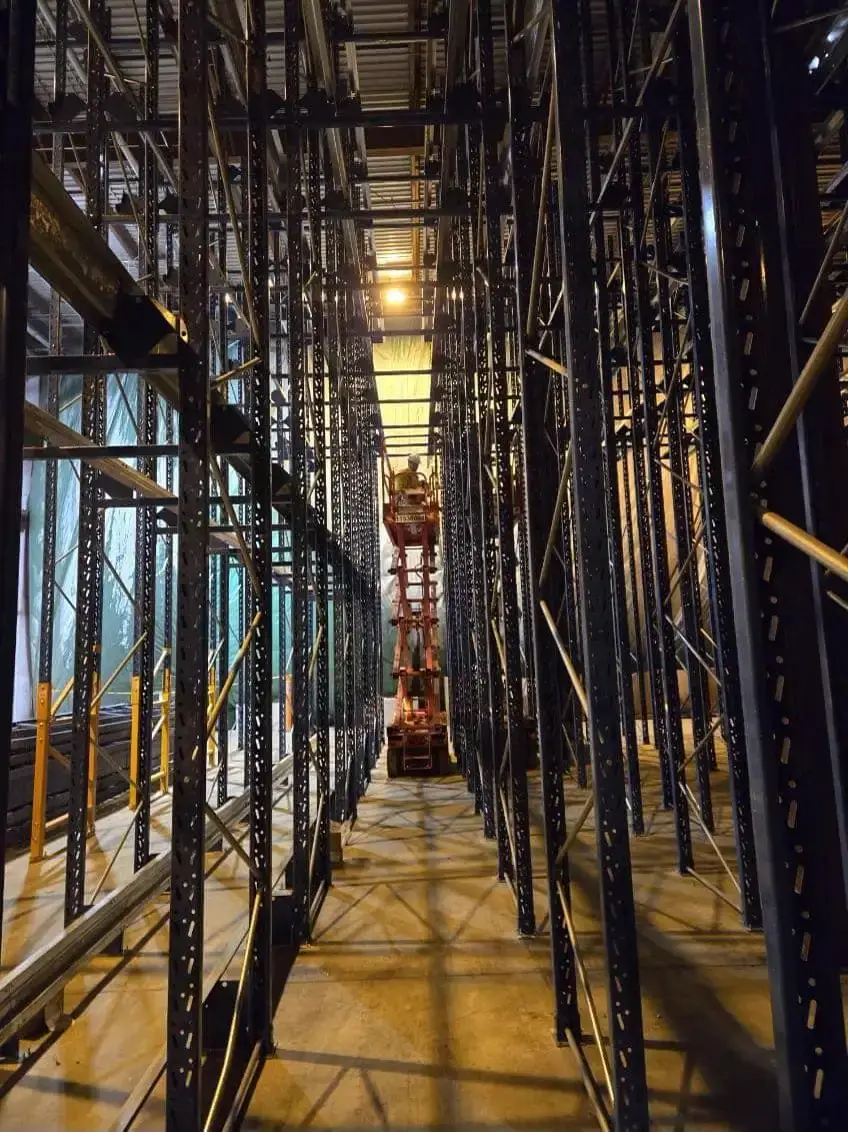
When floor space is at a premium and you are dealing with large quantities of the same product, Drive-In racking becomes the superior choice. Unlike selective systems, Drive-In racking eliminates aisles by allowing forklifts to drive directly into the racking bays to place or retrieve pallets. This system operates on a 'Last-In, First-Out' (LIFO) principle. It is essentially a high-density storage block where pallets are stored on continuous rails rather than beams. This can increase storage capacity by up to 75% compared to standard selective racking, making it a favorite for cold storage facilities where every cubic foot of refrigerated air is an expensive overhead cost.
Drive-In systems are best suited for 'homogenous' inventory, situations where you have hundreds of pallets of the same SKU. Because the forklift must enter the structure, the racking is built with heavy-duty components and reinforced bracing to withstand potential impacts. While the cost-per-pallet position is higher than selective racking due to the additional steel required for rails and specialized uprights, the total cost of ownership can be lower when considering the reduced footprint and potential for lower facility utility costs. However, it requires highly skilled operators, as navigating a 4,000-pound forklift inside a narrow steel structure requires precision and safety awareness.
The FIFO vs. LIFO Dilemma: Operational Impact
The choice between Selective and Drive-In racking often boils down to your inventory rotation requirements. Selective racking is the gold standard for FIFO (First-In, First-Out). This is critical for industries like pharmaceuticals, food and beverage, and consumer electronics, where product obsolescence or expiration is a constant risk. In a FIFO environment, you need to ensure the oldest stock is picked first. Selective racking allows your team to reach any pallet at any time, facilitating perfect rotation without 'honeycombing', the phenomenon where empty spaces occur deep within a rack that cannot be filled until the front pallets are removed.
Conversely, Drive-In racking is fundamentally a LIFO (Last-In, First-Out) system. The last pallet pushed into the lane is the first one that must be pulled out. This is perfectly acceptable for non-perishable goods, raw materials like steel or timber, or high-volume consumer goods with long shelf lives. However, if LIFO is applied to the wrong inventory, you risk 'buried' stock that expires or becomes obsolete. Data suggests that improper rack selection can lead to a 15-20% increase in inventory write-offs in facilities handling perishable goods. Therefore, analyzing your SKU velocity and expiration profiles is a mandatory prerequisite before committing to a high-density LIFO system.
Space Utilization and Throughput Dynamics
To visualize the difference in space utilization, consider a 50,000-square-foot facility. Using selective racking, you might achieve a storage capacity of 5,000 pallets. By switching to a Drive-In system for 60% of that inventory, you could potentially increase that capacity to 8,500 pallets within the same footprint. This 'densification' is a powerful tool for companies looking to avoid the massive capital expenditure of a building expansion. However, density often comes at the price of throughput speed. In a selective system, multiple forklifts can work different aisles simultaneously without interference. In a Drive-In system, travel speeds are slower because operators must carefully enter and exit the rack lanes.
Throughput, the speed at which pallets move in and out of the facility, is often higher with selective racking because of the reduced 'travel and search' time. In a Drive-In environment, if the specific pallet needed is three positions deep, the operator must move the two pallets in front of it, significantly increasing labor time. This is why Drive-In racking is rarely used for 100% of a facility's needs. Instead, the most efficient warehouses utilize a hybrid approach: Selective racking for high-velocity, diverse SKUs and Drive-In racking for bulk storage of slower-moving or high-volume identical items. Balancing these two can optimize both storage density and picking speed.
Safety, Maintenance, and Structural Integrity
Safety is a paramount concern when comparing these two systems. Drive-In racking is inherently more prone to forklift damage because the vehicle actually enters the rack structure. Even a minor collision can compromise the structural integrity of a high-density system. To mitigate this risk, Drive-In systems require heavy-duty floor-mounted guide rails, reinforced 'bullnose' uprights, and frequent safety inspections. The Rack Manufacturers Institute (RMI) suggests that high-density systems should be inspected at least twice a year, or immediately following any reported impact. Selective racking, while still requiring safety precautions, offers wider aisles and less opportunity for structural contact.
Maintenance costs also differ. Selective racking is straightforward to repair; if a beam is damaged, it can be replaced relatively quickly with minimal disruption. In a Drive-In system, damage to a rail or a rear brace may require the unloading of an entire bay or even multiple adjacent bays to ensure the structure is safe for repair. Furthermore, the lighting requirements for Drive-In systems are more complex; since forklifts enter the racks, overhead lighting must be positioned to illuminate the interior of the lanes to prevent accidents. When budgeting for your system, factor in a 5-10% higher annual maintenance reserve for Drive-In racking to account for these operational realities.
Calculating the ROI: Which System Wins?
The Return on Investment (ROI) for racking is not just about the initial purchase price. For selective racking, the ROI is driven by labor efficiency and SKU flexibility. If your labor costs are high and your orders are complex (many small orders with different items), selective racking wins by minimizing the time workers spend 'shuffling' pallets. For Drive-In racking, the ROI is driven by real estate savings. If you are operating in a high-rent market like Southern California, New Jersey, or the GTA in Canada, the ability to store 40% more pallets in the same space can save hundreds of thousands of dollars in annual lease costs.
Consider this practical example: A cold-storage facility storing frozen vegetables. The cost of electricity to cool the space is a fixed high cost. By using Drive-In racking, they maximize the pallet count per cubic foot of cooled air, directly reducing the 'utility cost per pallet.' In this scenario, the higher initial cost of the Drive-In system is often recouped within 18 to 24 months through energy and space savings. Conversely, an e-commerce fulfillment center with 20,000 different SKUs would find Drive-In racking impossible to manage, leading to a negative ROI through lost productivity and shipping delays. The 'winner' is entirely dependent on your specific business metrics.
Conclusion: Making the Strategic Choice
Choosing between selective and drive-in racking is a foundational decision that will dictate your warehouse’s performance for years to come. Selective racking offers the agility, speed, and 100% accessibility required for complex, high-SKU operations and strict FIFO requirements. Drive-in racking provides the high-density 'brute force' storage needed to maximize square footage for high-volume, homogenous inventory. The most successful modern facilities often move away from a 'one-size-fits-all' approach, instead opting for a strategic blend of both systems to balance density with accessibility. Key takeaways include: assess your SKU count, determine your rotation needs (FIFO vs. LIFO), and calculate the long-term value of floor space versus labor speed.
At MTLI Group, we specialize in helping industrial facilities across North America navigate these complex decisions. From engineering and design to professional installation and facility management, our team ensures your racking system is an engine for growth. Whether you need the precision of a selective system or the density of a drive-in solution, MTLI Group has the expertise to optimize your space and streamline your operations. Contact us today to discuss your next warehouse transformation project.