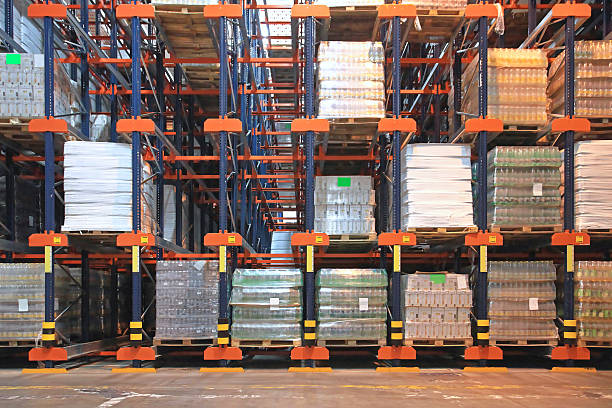
Two facilities can store the same products and still need very different racking systems. One may choose drive in pallet racking to maximise storage density and make the most of available space. Another may prefer a drive-through system to keep inventory moving efficiently. At first glance, the two designs look similar, but they work quite differently in practice.
With decades of experience installing both systems in Canadian facilities, MTLI Group understands what each option can bring to a warehouse. Below, we break down the key differences between drive-in and drive-thru pallet racking and explain how to determine which system makes the most sense for your operation.
What Is Drive In Pallet Racking?
Drive-in racking lets a forklift drive directly into a storage lane to place or retrieve a pallet. Pallets sit on rails along the sides of the lane, stacked several deep, with only one point of entry.
That single entry point is the defining feature. It means pallets go in and come out from the same side, which naturally creates a last-in, first-out storage pattern. Drive-in warehouse racking works well when product does not need strict rotation, since the pallets loaded last are the ones retrieved first. A drive in warehouse racking layout like this is common wherever density matters more than picking order.
A few things that make drive in racking distinct:
- Single access point: Forklifts enter and exit from one end only
- High density: Lanes can store multiple pallets deep, cutting down on aisle space
- LIFO storage: Last pallet in is usually the first one out
Overall, drive-in racking is a strong choice for high-volume storage where products are stored in larger batches and inventory rotation is less critical. Its dense design can help facilities make better use of available warehouse space without adding more floor area.
What Is Drive-Thru (Drive-Through) Racking?
Drive through racking looks almost identical to drive-in racking at first glance. But it has one key difference: a second opening at the opposite end of the lane.
That second access point changes everything about how inventory flows. Forklifts can load from one side and retrieve from the other, creating a first-in, first-out pattern. This makes drive-thru systems a natural fit for products with expiration dates or strict rotation requirements.
Key traits of a drive-through racking system:
- Two access points: One at each end of the storage lane
- FIFO storage: Oldest pallets get picked first
- Similar density to drive-in: Storage depth remains high, though layout needs access on both sides
In short, drive-through racking makes sense for warehouses that need dense storage without sacrificing inventory rotation. The two-sided design keeps products moving in a predictable FIFO sequence while maximising available storage capacity.
Comparing Drive-In and Drive-Thru Racking Side by Side
Before choosing between the two, it helps to see exactly where they overlap and where they differ. Here's how a typical drive in pallet racking system stacks up against a drive-through configuration.
| Factor | Drive-In Racking | Drive-Through Racking |
|---|---|---|
| Access points | One | Two |
| Rotation pattern | LIFO (last in, first out) | FIFO (first in, first out) |
| Storage density | Very high | Very high |
| Layout flexibility | Works against a wall or back-to-back | Needs clear access on both ends |
| Best suited for | Bulk, non-perishable goods | Perishable or date-sensitive goods |
Both systems trade selectivity for density. Neither gives a forklift operator direct access to every pallet the way selective racking does. The real decision usually comes down to whether your inventory needs FIFO rotation or not. For facilities without that requirement, drive in pallet racking tends to win on cost and simplicity.
Why Canadian Warehouses Are Investing in Denser Storage
Storage space is not getting any easier to find. According to Innovation, Science and Economic Development Canada , there are more than 5,280 warehousing and storage establishments operating across the country, and over 92 percent of them employ fewer than 100 people. That is a lot of smaller operations competing for the same industrial real estate.
With space at a premium, drive-in racking systems and similar high-density configurations have become a practical way for facilities to grow their storage capacity without expanding their footprint. A well-planned drive in pallet racking layout can often add meaningful capacity within a building's existing footprint alone.
Where Drive-In Racking Works Best
Drive in pallet racking tends to perform best for operations with a narrow product mix and consistent, bulk-format inventory.
Good candidates for a drive in racking system include:
- Distribution centres storing large quantities of a small number of SKUs
- Manufacturers stockpiling raw materials or finished goods before shipment
- Seasonal storage where product sits for months without needing rotation
- Bulk retailers holding large volumes of non-perishable stock
Facilities in the warehousing and distribution sector often lean toward drive-in configurations when SKU counts stay low and density matters more than accessibility.
A helpful test: if your team can honestly say "it doesn't matter which pallet comes out first," drive-in racking is probably the right call. That single question rules out a surprising number of edge cases before you even look at cost.
Where Drive-Through Racking Works Best
Drive-through racking earns its keep in operations where product freshness or rotation order actually matters.
Good candidates for drive through racking include:
- Cold storage facilities managing perishable goods on a strict rotation schedule
- Food and beverage distributors working with expiration dates
- Pharmaceutical storage where lot tracking and rotation are non-negotiable
- Any operation where FIFO discipline affects product quality or compliance
Businesses in cold storage operations are among the most consistent users of drive-through systems, since spoilage risk makes FIFO rotation a requirement rather than a preference.
Even outside cold storage, any operation with lot tracking, audit requirements, or contractual shelf-life guarantees tends to find drive-through racking worth the extra layout complexity.
Selectivity and Storage Density Trade-offs
Both drive-through and drive in pallet racking sacrifice selectivity for density. That trade-off is worth understanding clearly before committing to either one.
Here's how that trade-off plays out compared to other common racking types.
| Racking Type | Storage Density | Selectivity | Rotation |
|---|---|---|---|
| Selective racking | Low to moderate | High | Flexible |
| Drive-in racking | High | Low | LIFO |
| Drive-through racking | High | Low | FIFO |
| Pallet flow racking | High | Moderate | FIFO |
Facilities that need both density and rotation sometimes look at pallet flow racking as a middle ground, since it enforces FIFO through gravity rollers rather than a second access point.
Staying Compliant and Safe
Drive-thru and drive in pallet racking both carry unique safety considerations because forklifts operate inside the storage structure itself, not just alongside it.
Provincial regulators take this seriously. Alberta's Occupational Health and Safety guidelines require storage racks to be designed, assembled, and maintained to support their rated load, placed on a firm and level foundation, and properly anchored or braced based on height. Regular inspection for damage, such as twisted uprights or sagging beams, is expected across every province.
A few safety basics specific to drive-in and drive-through systems:
- Rail alignment: Pallet support rails need to stay level and undamaged for safe entry
- Column protection: End columns and entry points take the most forklift contact and need guarding
- Operator visibility: Drivers have limited sightlines once inside a lane, which calls for extra caution
Good maintenance and safe operating practices go hand in hand. When both are in place, drive in pallet racking and drive-thru systems can provide dense storage without compromising the safety of the warehouse.
Installation and Cost Differences
Drive-in and drive-through racking generally cost more per pallet position than basic selective racking, since the structural framework has to support pallets stacked several deep without intermediate beams for support.
A few cost factors worth planning around:
- Structural steel: Both systems use more steel per position than selective racking
- Engineering requirements: Taller, denser configurations often need structural review
- Access requirements: Drive-through systems need clear space on two sides instead of one, which can affect layout costs
Getting accurate numbers requires a site-specific quote, since building height, floor conditions, and seismic requirements all factor into the final cost. A qualified installation partner can walk through those specifics before you commit to either system.
Installation timelines also tend to run a bit longer for high-density systems than for selective racking, mostly due to the extra structural bracing and the precision required to keep lanes properly aligned.
Common Mistakes to Avoid
Facilities sometimes choose between drive-in and drive-through racking based on cost alone, without fully accounting for how their inventory actually moves.
Watch for these common missteps:
- Ignoring rotation needs: Choosing drive-in racking for perishable inventory that actually needs FIFO
- Underestimating lane depth: Building lanes deeper than your typical order volume can efficiently use
- Skipping regular inspection: High-density systems hide damage more easily than open selective racking
- Overlooking forklift compatibility: Not every forklift can safely operate inside a drive-in lane
A routine inspection program catches most of these issues before they become safety incidents or costly repairs.
How MTLI Group Supports Your Racking Project
MTLI Group has spent decades designing and installing racking systems across Canadian facilities, including drive thru and drive in pallet racking configurations built around real inventory profiles, not generic templates.
Our team evaluates your building height, floor conditions, and rotation requirements before recommending a system. Once your racking is installed, our maintenance programs help keep it inspected and performing safely for years afterward.
Choosing the System That Fits Your Operation
There is no universal winner between drive-through and drive in pallet racking systems. The right choice comes down to how your inventory actually moves through your facility, not just how much you can pack into a given footprint.
If your product needs strict rotation, drive-through is almost always the better fit. If it doesn't, drive in pallet racking usually delivers more density for less structural complexity.
MTLI Group can help you evaluate which system makes sense for your facility. Contact our team to discuss your goals and next steps.