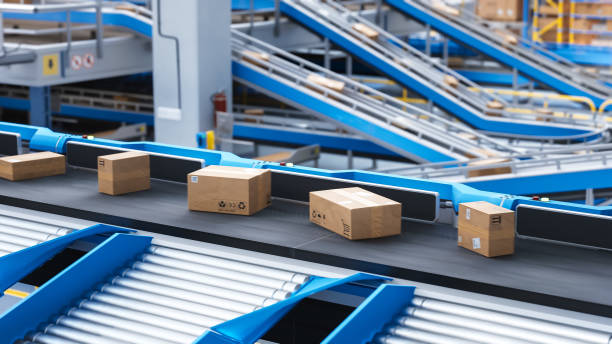
Walk through any high-volume fulfillment centre and the first thing you notice is what you don’t see: people carrying boxes across the floor. Warehouse conveyor systems move that work instead, and conveyor sorters take it a step further, routing each item to the right destination without anyone touching it along the way.
This guide covers how conveyor systems work, the main types available, and where conveyor sorters fit into a modern warehouse layout. For a plain-language primer, our guide to what a conveyor system actually is covers the basics for teams exploring the option for the first time.
What Conveyor Systems and Conveyor Sorters Do for a Warehouse Floor
At its core, a conveyor system automates the movement of product between points in a facility, replacing manual carrying or repeated forklift trips with a continuous, powered path. Conveyor sorters build on that same idea, adding the routing logic that decides where each item goes once it reaches a decision point on the line.
Our own breakdown of how conveyor systems improve warehouse efficiency looks at this in more depth, covering throughput gains facilities typically see after installation. Conveyors and conveyor sorters rarely work in isolation. Most modern lines connect into a broader warehouse automation network, syncing with inventory software and sometimes robotics to move product with minimal manual input at any stage.
Parts That Make Conveyor Sorters Run Smoothly
A conveyor line is built from a defined set of components, and the right combination depends on what a facility is moving and how fast.
Belt sections carry lighter, irregular items smoothly across flat or inclined paths. Roller sections handle heavier cartons and pallets, using gravity or powered rollers to move loads with less friction. Diverters make up the core of conveyor sorters, routing product to different destinations along the line based on barcode, weight, or destination data. Motors, sensors, and control panels tie the whole system together, adjusting speed and routing in real time as product moves through.
Getting these pieces sized correctly from the start matters more than it seems, especially on a line running conveyor sorters at high volume. Our conveyor installation team designs every line around actual product dimensions and throughput targets rather than a generic template, and our dedicated conveyor systems division carries that design through to full integration with existing warehouse software.
Conveyor Sorter Types Worth Knowing
Not every facility needs the same conveyor sorters, and the right choice depends heavily on product type, order volume, and how much sorting the operation requires.
Belt conveyors suit light, uniform items moving along a straight or gently curved path, with no sorting function built in. Roller conveyors handle heavier cartons and pallets, often used in receiving and shipping zones. Sliding shoe conveyor sorters divert cartons gently off the main line without stopping flow, a common choice for fragile or irregular items. Cross-belt conveyor sorters use small moving belts mounted on a loop to sort at very high speed, suited to operations with large volumes of small parcels.
| Conveyor or Sorter Type | Best For | Relative Speed |
|---|---|---|
| Belt Conveyor | Light, uniform items | Moderate |
| Roller Conveyor | Heavy cartons, pallets | Moderate |
| Sliding Shoe Conveyor Sorters | Fragile or irregular items | Fast |
| Cross-Belt Conveyor Sorters | High-volume small parcel sorting | Very fast |
Operations in e-commerce fulfillment often lean toward cross-belt or sliding shoe conveyor sorters to keep pace with high order volume and frequent SKU variation, while general warehousing and distribution facilities more commonly rely on a mix of belt and roller conveyors for bulk movement, adding conveyor sorters only where the order profile calls for them.
The Labour Math Behind Investing in Conveyor Sorters
Material handling conveyors, and conveyor sorters in particular, are becoming a bigger priority as the sector they serve keeps expanding. National data shows employment in transportation and warehousing rose 3.4 percent year over year as of May 2026, with gains of 19,000 jobs in that single month alone, reflecting steady growth in the sector’s overall activity.
At the same time, finding workers to fill that growth has not gotten noticeably easier. The job vacancy rate in transportation and warehousing fell to 2.7 percent in October 2025, the lowest level recorded since comparable data began in April 2015. A historically tight vacancy rate alongside steady sector growth means facilities are moving more volume with a labour pool that is not expanding at the same pace, which is exactly the gap conveyor sorters are built to close. Businesses serving 3PL and logistics clients feel this pressure most directly, since contract volume can grow faster than staffing can realistically keep up with.
What Conveyor Sorters Actually Return
The clearest return from warehouse conveyor systems comes from reduced manual transport time. Staff spend less time walking product across the floor and more time on picking, packing, or quality control, work that actually adds value to an order. Adding conveyor sorters to the line extends that benefit further, since sorting decisions that once required a person reading labels now happen automatically as product passes through.
Throughput consistency improves too. Conveyor sorters move product at a steady, predictable pace regardless of staffing levels on a given day, which smooths out the swings in output that manual sorting tends to produce during busy or short-staffed shifts.
| Factor | Manual Transport and Sorting | Conveyor Sorters |
|---|---|---|
| Labour Required for Movement | High | Low |
| Throughput Consistency | Variable | Steady |
| Risk of Product Damage | Higher, more handling | Lower, controlled movement |
| Scalability During Peak Volume | Limited by staffing | Higher, fixed system capacity |
Facilities in manufacturing see similar gains when conveyors move materials and finished goods between production stages, while food and beverage operations benefit from the reduced handling conveyor sorters allow, since fewer manual touches generally means better product consistency through the line.
Setup Errors That Slow Conveyor Sorters Down
The most common mistake is sizing conveyor sorters for current volume only, without planning for seasonal spikes or future growth. Sorters that run smoothly most of the year but bottleneck hard during peak season defeat much of the purpose of automating in the first place.
Poor layout planning causes a different kind of problem. A conveyor sorter route that does not account for existing storage racking placement can force awkward detours or dead zones on the floor, cutting into the efficiency gains the system was meant to deliver. Skipping a regular maintenance schedule is another frequent gap, since belts, rollers, and diverters wear with continuous use and a single failed sensor can stop an entire sorter line. Pairing conveyor installation with an ongoing facility maintenance plan helps catch this kind of wear before it causes a full stoppage.
MTLI’s Work on Warehouse Conveyor Systems and Sorters
MTLI Group designs and installs warehouse conveyor systems, including conveyor sorters, based on actual product flow and volume data rather than a one-size-fits-all layout. Our process starts with mapping how product currently moves through a facility, then builds conveyor sorters around that reality. Our full breakdown of how conveyor systems improve warehouse efficiency covers several real configuration examples in more detail.
We also integrate every conveyor sorters project with broader warehouse automation planning, so new lines work alongside existing or planned storage and retrieval systems instead of being bolted on as a standalone addition.
Talk to MTLI About Sorters for Your Warehouse
Warehouse conveyor systems give facilities a practical way to move more product without adding proportional headcount, a gap that is only growing as the sector expands faster than its available labour pool. Well-designed conveyor sorters keep product moving and routing correctly, even during the busiest stretches of the year.
MTLI Group works with businesses across Canada to design and install warehouse conveyor systems and conveyor sorters suited to their specific product mix and volume. Contact our team to talk through your facility’s conveyor and sorting needs.