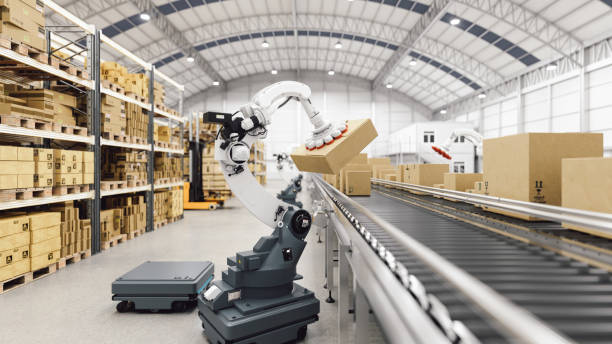
The warehouse of the future is not ten years away. It is being built right now. Across North America, facilities are adding robotic systems, AI-driven controls, and sensor networks that allow buildings to operate with far less direct human intervention than any previous generation of warehouse technology allowed. For supply chain strategists, understanding where this shift is heading is not optional. It is part of the job.
An autonomous warehouse is a facility where the core material handling, storage, and retrieval functions operate through automated systems with minimal manual direction for each individual task. Workers are still present. But they oversee systems rather than perform every physical step themselves. The result is a facility that runs faster, more accurately, and more consistently than a manually operated one of the same size.
MTLI designs and builds automated warehouse systems for North American facilities at varying stages of this transition. This guide covers the technologies defining the autonomous warehouse, where North America stands in the adoption curve, and what supply chain strategists need to plan for now.
What Makes a Warehouse Truly Autonomous
The term "autonomous" covers a spectrum. At one end, a facility with a single automated conveyor is not autonomous. At the other end, a facility where robotic systems handle receiving, storage, retrieval, picking, packing, and outbound sorting with human oversight only at the exception level is genuinely autonomous.
Most North American facilities sit somewhere between these two points right now, and the direction of movement is clear. According to Statistics Canada, the share of Canadian businesses using AI to produce goods or deliver services reached 19.2% in Q2 2026, tripling from 6.1% in Q2 2024. This acceleration reflects a broader technology adoption shift that is flowing through every sector, including logistics and warehousing.
A fully automated warehouse typically combines several systems working together. ASRS (Automated Storage and Retrieval Systems) handle storage and retrieval. Autonomous Mobile Robots (AMRs) handle floor-level transport. Robotic arms or goods-to-person systems handle picking. Automated sortation systems handle outbound routing. And AI controls software coordinates all of these layers in real time, making routing and sequencing decisions faster than any human dispatcher could.
The Core Technologies Driving Autonomous Warehousing
AI warehouse systems are the control layer that makes true autonomy possible. Without AI, each automated system runs on fixed rules. With AI, the system learns from real operational data and improves its decisions over time.
Here is how the key technologies combine in a fully autonomous warehouse environment.
- ASRS with AI optimisation: Traditional ASRS stores and retrieves from fixed locations on a fixed schedule. AI-optimised ASRS continuously adjusts where products are stored based on demand patterns, anticipating which items will be needed and positioning them for faster retrieval before a pick request even arrives.
- AMRs with dynamic path planning: Early Automated Guided Vehicles (AGVs) followed fixed floor paths. Modern AMRs build maps of the facility and navigate dynamically. When a path is blocked, the robot re-routes without waiting for a human to intervene. When multiple robots operate together, the AI coordinates their routes to avoid conflict.
- Robotic picking with computer vision: Computer vision allows robotic arms to identify and grasp a wide range of product types and packaging formats. Early robotic picking was limited to uniform, predictable items. Vision-guided picking has expanded this range significantly, making robotic picking viable in operations with broader SKU variety.
- Predictive maintenance through IoT: Sensors on every piece of automated equipment monitor vibration, temperature, and motor load continuously. The AI system analyses this data and predicts which components are approaching failure. Maintenance is scheduled before a breakdown rather than after it.
Autonomous Warehouse Technology Layers
| Technology | Primary Function | Autonomous Capability |
|---|---|---|
| ASRS with AI optimisation | Storage and retrieval | Anticipates demand, pre-positions stock |
| AMRs with dynamic routing | Floor transport | Re-routes in real time around obstacles |
| Computer vision picking | Item picking | Handles broad product variety autonomously |
| Automated sortation | Outbound routing | Routes every item without manual decisions |
| Predictive maintenance IoT | Equipment health | Flags failures before they occur |
Where North America Stands in the Transition
North American adoption of autonomous warehouse technology is accelerating, but unevenly. Large e-commerce operators and major retailers have been building fully automated fulfilment facilities for several years. The technology in these facilities is now proven and commercially available to mid-size operators at a broader range of budget levels than five years ago.
Canadian adoption has lagged behind the United States in several technology categories, including warehouse robotics and AI integration. This gap is starting to close as both the technology cost and the labour cost equation shift. Facilities that move toward autonomous warehouse capability now benefit from several years of learning before the competitive pressure to automate becomes unavoidable across the sector.
What Fully Automated Warehouse Facilities Look Like in Practice
A fully automated warehouse in operation looks very different from a conventional one. The building is often darker, since automated equipment does not need the same lighting that workers require. The aisles are narrower, since AMRs and ASRS cranes need less clearance than manned forklifts. The noise profile is different, a consistent mechanical hum rather than the variable noise of a manually operated floor.
Workers are present, but in different roles. They monitor dashboards that show real-time system performance. They handle exceptions that the automated system flags rather than processing routine picks. They manage the inbound and outbound dock interfaces where human judgement still adds value. And they maintain the equipment, guided by the predictive maintenance data the system generates.
This shift in the workforce role is one of the most important planning considerations for supply chain strategists. The skills required for an autonomous warehouse are different from those required for a manual one. Operational oversight, data interpretation, and equipment troubleshooting replace walking, lifting, and manual sorting.
The Infrastructure Autonomous Warehouses Require
Building or converting to an autonomous warehouse requires more than purchasing robotic equipment. The building must support the technology from a structural and electrical standpoint.
ASRS installations need floors engineered to support tall, heavy racking structures. AMR fleets need smooth, flat floors with reliable network coverage throughout the facility. AI control systems need server infrastructure and connectivity that meets uptime requirements. Electrical capacity must support not just current equipment but planned expansion phases.
MTLI's construction and general contracting team manages this infrastructure work alongside the automation installation, so the building and the technology are developed as one integrated project. Facilities in manufacturing that are adding autonomous systems to support production line feeding often need the most significant structural preparation work, since manufacturing facilities were not always built with ASRS loading in mind.
Typical Autonomous Warehouse Transition Phases
| Phase | Core Activity | Estimated Duration |
|---|---|---|
| Assessment | Building suitability, operations mapping | 1 to 2 months |
| Infrastructure | Floor, electrical, and network preparation | 3 to 6 months |
| Automation installation | ASRS, AMRs, conveyor, controls | 4 to 8 months |
| Software and AI integration | WMS connection, AI training on real data | 2 to 4 months |
| Workforce transition | Training, new role definition, go-live | 1 to 2 months |
Common Mistakes Supply Chain Strategists Make When Planning for Autonomous Operations
A few mistakes come up when organisations plan toward autonomous warehouse capability.
- Treating autonomy as a single project rather than a phased programme: Most facilities transition in phases over several years. Planning for this from the start delivers better outcomes than treating the first phase as the complete solution.
- Underestimating the data foundation needed for AI to work: AI systems learn from data. If inventory records are inaccurate or operational data is fragmented, the AI layer will underperform regardless of the hardware installed.
- Ignoring workforce transition planning: Workers whose roles change significantly need real support, not just a go-live briefing. Organisations that invest in this transition see faster adoption and fewer operational problems in the first months.
- Selecting automation before confirming building suitability: Equipment requirements and building capability must be matched before procurement. Discovering a floor load or ceiling height constraint after equipment is ordered is an expensive problem.
How MTLI Supports the Transition to Autonomous Operations
MTLI manages automation projects at every stage of the transition toward autonomous warehouse operations. Our warehouse automation team assesses current operations and recommends the sequence of automation investments that builds toward autonomous capability in a phased, manageable way.
For facilities in cold storage and food and beverage, autonomous systems carry additional benefits around temperature control consistency and traceability that manual operations cannot match. Our teams design for these specific requirements alongside the standard automation scope. Our installations team manages the full commissioning process, and our facility management services keep the automated systems running reliably once they are live.
Planning Now for the Autonomous Warehouse
The autonomous warehouse is not a distant concept. It is a direction that facilities across North America are moving toward at different speeds. Supply chain strategists who start planning for this transition now, even if full autonomy is several years away, make better technology and infrastructure decisions in the shorter term.
Every automation investment a facility makes today should be evaluated not just on its immediate return but on whether it builds toward the more connected, more autonomous facility the operation will need in five years.
If your operation runs in warehousing and distribution or 3PL and logistics, MTLI can help you assess your current position on the automation curve and build a roadmap toward more autonomous warehouse capability.
Contact MTLI to start a facility assessment.