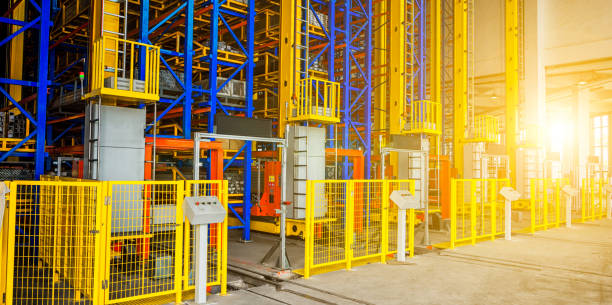
A pallet sitting idle in an aisle for even a few minutes adds up fast once you multiply it across thousands of moves a day. Manual forklift travel, searching for the right slot, double-handling product that should have gone straight to storage, these small inefficiencies quietly eat into throughput long before anyone notices the pattern on a spreadsheet. A pallet ASRS system removes that guesswork entirely, retrieving and placing loads with a precision no manual process can match consistently.
MTLI designs and installs pallet ASRS systems for Canadian warehouses looking to solve exactly this kind of bottleneck. This guide covers the main types available, where they deliver the most value, and what to actually expect from the investment before you start comparing vendors.
What Makes Pallet ASRS Different from Standard Racking?
Standard pallet racking relies on a forklift operator to retrieve and store every load manually. A pallet ASRS, or Automated Storage and Retrieval System, replaces that manual step with a machine, typically a crane, shuttle, or robotic vehicle, that moves on a fixed path to place and retrieve pallets automatically based on instructions from a warehouse management system.
The difference isn’t just speed. It’s consistency. A machine retrieves the same load the same way every time, regardless of shift changes, operator fatigue, or how busy the floor gets during peak hours. That consistency also shows up in safety outcomes, since fewer manual forklift movements through dense aisles generally means fewer opportunities for collisions or dropped loads. Our pallet ASRS installation team works through this exact comparison with clients during the early planning stage, since the decision to automate storage isn’t always obvious until the numbers are laid out side by side.
How a Pallet ASRS System Actually Works
At its core, a pallet ASRS system runs on three coordinated parts: the physical storage structure, the retrieval mechanism, and the software directing both. The storage structure is typically a dense racking configuration built specifically around the retrieval machine’s dimensions and travel path, rather than a standard rack layout retrofitted after the fact.
The retrieval mechanism varies by system type, but its job stays the same: move to the correct storage location, extract or place the pallet, and return it to the destination point without a person physically touching the load. Software ties it together, tracking exact inventory location and directing the machine’s next move in real time. Rather than relying on a worker’s memory or a paper pick list, the system knows precisely where every pallet sits and how quickly it can be reached. Our ASRS guide breaks down this process in more technical detail for teams wanting a deeper look before committing to a design.
A few things worth understanding upfront:
- Pallet ASRS systems are purpose-built around specific load dimensions and weights
- Software integration with existing warehouse management tools is just as important as the physical equipment
- Ceiling height and floor load capacity both directly shape which system type fits a given building
- Maintenance access points need to be designed into the structure, not added as an afterthought once the system is running
Key Types of Pallet ASRS Systems
Not every pallet ASRS system works the same way, and the right type depends heavily on throughput needs, building dimensions, and how often specific SKUs move.
| System Type | How It Retrieves Loads | Best Fit |
|---|---|---|
| Unit-Load Crane ASRS | Fixed-aisle crane moves vertically and horizontally | High-density storage, lower SKU variety |
| Shuttle-Based ASRS | Shuttles travel within racking levels, lifts move between levels | High-throughput, frequent small-batch retrieval |
| Mini-Load ASRS | Handles totes or cases rather than full pallets | Mixed pallet and case-pick operations |
| Deep-Lane ASRS | Stores multiple pallets deep per lane | Very high-density bulk storage |
Choosing between these types usually comes down to a tradeoff between density and access speed. A deep-lane system packs in the most product per square foot but sacrifices some retrieval speed for individual pallets buried deeper in a lane. A shuttle-based system trades some density for faster, more flexible access across a wider range of SKUs. Many facilities end up blending two types within the same building, running a crane-based system for bulk reserve storage and a shuttle-based layer for faster-moving product closer to shipping.
Where ASRS Systems Deliver the Most Value
ASRS systems aren’t a universal fit for every warehouse, but a handful of operational patterns consistently point toward strong returns. Facilities with limited floor space but tall ceiling clearance benefit the most, since a pallet ASRS system makes full use of vertical space that manual forklifts simply can’t reach as efficiently.
Operations running with tight labor margins or facing chronic staffing gaps also see outsized benefit, since the system doesn’t require continuous operator attention to run at full capacity. Cold storage facilities fall into this category especially often, given how expensive it is to keep staff working efficiently in low-temperature environments for extended periods. Reducing the number of staff hours spent inside a freezer or cooler, while still maintaining full retrieval speed, is one of the clearest cost arguments for automating storage in this type of facility.
The Labor Case for an ASRS Warehouse
Labor availability is one of the strongest arguments for building an ASRS warehouse right now. Transportation and warehousing employers reported a job vacancy rate of 3.0 percent in December 2025, with 26,700 unfilled positions against 865,500 payroll employees, according to Statistics Canada. That gap sits above the national average vacancy rate across most other sectors tracked in the same release.
For facilities already struggling to keep shifts fully staffed, automating the most repetitive and physically demanding storage tasks removes a significant portion of that staffing pressure entirely. Operations in warehousing and distribution are feeling this pinch directly, since the sector competes for the same labor pool as transportation and logistics more broadly, and a prolonged vacancy in a single shift can slow an entire facility’s throughput far more than the headcount gap would suggest on paper.
Throughput, Density, and the Economics of Pallet ASRS
The financial case for pallet ASRS tends to come down to two numbers: how much more product fits in the same footprint, and how much faster retrieval happens compared to manual methods.
| Metric | Manual Racking | Pallet ASRS |
|---|---|---|
| Storage Density per Square Foot | Baseline | 40 to 60 percent higher in most configurations |
| Retrieval Accuracy | Dependent on operator | Consistently high, software-directed |
| Labor Required for Retrieval | Continuous operator time | Minimal, system-directed |
| Peak Period Performance | Degrades under pressure | Consistent regardless of volume |
Facilities in manufacturing that store both raw materials and finished goods often see the clearest payback, since dense, accurate storage directly reduces the time production staff spend waiting on inbound or outbound material. That waiting time rarely shows up as a line item on a budget, but it compounds across every shift, which is exactly why the return on a pallet ASRS investment tends to look better the longer a facility tracks it.
E-Commerce Growth and Rising Storage Demand
The broader retail picture adds another layer to why pallet ASRS investment is accelerating. Canadian retail e-commerce sales climbed 6.0 percent year over year to $5.5 billion in July 2026, according to Statistics Canada, continuing a steady upward trend in online order volume. More online orders typically mean more SKUs moving through fulfillment centers with tighter turnaround expectations than traditional bulk shipping allows.
Operations built around e-commerce fulfillment feel this pressure most acutely, since every additional order adds pick-and-pack complexity that manual storage struggles to scale with efficiently. A pallet ASRS system doesn’t eliminate that complexity entirely, but it removes the storage and retrieval bottleneck that often sits upstream of the picking process itself.
Common Mistakes When Planning a Pallet ASRS Installation
Sizing the system for current volume without accounting for growth is one of the most frequent and costly mistakes. A pallet ASRS system is a significant structural investment, and retrofitting it for higher capacity down the line is far more disruptive than planning for growth from the outset.
Skipping a proper site assessment before finalizing system type is another common issue, leading to mismatches between ceiling height, floor load capacity, and the equipment ultimately selected. A few other pitfalls worth watching for:
- Choosing a system based on price alone without confirming throughput requirements
- Underestimating the software integration work needed to connect ASRS with existing inventory systems
- Failing to plan for ongoing facility maintenance, since ASRS equipment still requires scheduled inspection and calibration to perform reliably over time
- Overlooking how seasonal volume spikes will affect system capacity, rather than designing only around average daily throughput
How to Evaluate a Pallet ASRS Provider
Not every automation vendor brings the same depth of experience to a pallet ASRS project specifically. Some specialize narrowly in software, while others handle only the mechanical side, leaving the integration work to the client.
A few questions worth asking before signing a contract:
- Can they walk through a comparable pallet ASRS project in a similar facility type?
- Do they handle both the physical structure and the software integration under one team?
- What ongoing support is included once the system goes live?
- How do they size the system for both current volume and projected growth?
Our breakdown of ASRS systems explained for Canadian warehouses covers additional technical considerations worth reviewing before any vendor conversation, particularly around integration timelines and what to expect during commissioning.
What to Expect from MTLI’s ASRS Team
MTLI approaches pallet ASRS projects as a single accountable scope, covering site assessment, structural design, equipment installation, and software integration under one team. This avoids the coordination gaps that often appear when a facility manages racking, automation of hardware, and software integration through separate vendors.
Our installation crews handle the physical build directly, which keeps design intent consistent with what actually gets installed on site, rather than losing details in translation between separate design and construction teams. That continuity also makes post-installation support more straightforward, since the same team that built the system understands exactly how it was configured from day one.
The Bottom Line on Pallet ASRS Investment
A pallet ASRS system isn’t the right fit for every warehouse, but for facilities facing tight labor markets, rising storage demand, and limited floor space, it solves several problems at once rather than requiring separate fixes for each. Understanding the main system types and where each delivers the most value gives facility owners a much stronger starting point than jumping straight into vendor quotes.
MTLI works with Canadian businesses to assess whether a pallet ASRS system fits their operation and to design one sized for both current and future needs. Contact our team to start that conversation.